
Celestia Token Falls 8% as Its Promise of 21 Million Transactions Per Second Reveals Three Major Red Flags
Voyager claims 21 million transactions per second, but TIA fell 8.7% to $0.40; mainnet, signature verification, and recovery issues remain.
Celestia’s Voyager Benchmark Tops 21 Million Transactions per Second as TIA Falls 8.7% to $0.40
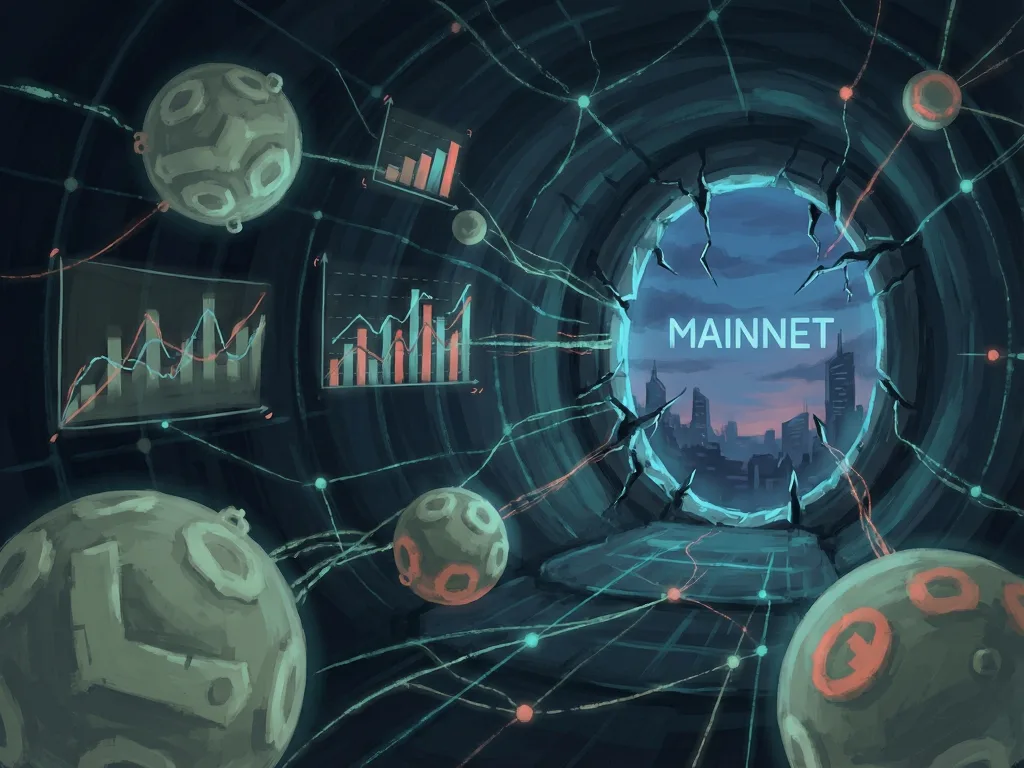
Celestia’s Voyager benchmark reported more than 21 million transactions per second across 100 million accounts while using only one CPU core for main execution. The figure, described by Staff Protocol Engineer Blazej Kolad in a recent blog, became the network’s most discussed November update. It arrived alongside a weaker market signal for TIA: the token traded around $0.40 at the time of writing, down 8.7% over 24 hours. The result gives readers a clear split to follow: Celestia is publishing high-throughput technology milestones, but the benchmark still carries three important production caveats.
Three limits behind the benchmark
The performance claim is not a live payment-network result. First, Voyager has not launched on the mainnet yet, so the benchmark does not represent proven production performance. Second, signature verification was excluded from the test. Signature checks are part of real-world transaction processing, and leaving them out can make a throughput figure look stronger than a full settlement path would. Third, crash recovery remains unfinished; production systems need reliable recovery mechanisms during unexpected failures.
Settlement Wire (@KatherineCody) said on November 14, 2026 that signature verification is the real test, noting that Voyager hit the speed on one CPU core with verification off and that comparisons with live payment networks are premature until verification is on. The post also asked how much throughput would survive.
Celestia’s November development record
The benchmark sits within a broader stretch of releases. Celestia launched Eden, an Ethereum Virtual Machine chain designed for AI agent trading experiments. Fibre went live on mainnet on October 20, introducing a data upload lane supporting approximately 128MB; previously, the network supported around 8MB. On October 29, Celestia introduced Voyager, a payments layer for AI agents. TIA perpetual futures secured a Decibel listing on November 4.
In the blog, Kolad said Voyager processed over 21 million transactions per second across 100 million accounts and used only one CPU core for main execution. Celestia argues that memory access matters more than additional processing cores: keeping relevant data nearby allows one core to handle substantial workloads. That framing helps explain why the project is highlighting a single-core result rather than a large server farm.
TIA price and supply pressure
TIA did not reflect the technical progress. The token traded around $0.40, an 8.7% decline over 24 hours, and the Relative Strength Index stood around 38.2. The indicator briefly moved above that level on November 12, but buyers failed to maintain the recovery.
The contrast is sharper against October levels. TIA approached $0.76 around the Eden launch, and the subsequent decline erased nearly half that value. The October 31 token unlock added approximately 5.58 million TIA, creating additional supply pressure during an already difficult period. Throughout November, TIA mostly traded between $0.41 and $0.45; the latest decline pushed the token below that range.
What to watch next
The next question is whether Voyager’s architecture can move from a benchmark to a production-ready payment layer without losing its claimed efficiency. The most useful test will be a mainnet launch with signature verification enabled and crash recovery completed. Until then, readers should treat the 21 million transactions per second figure as an engineering signal, not proof of live network capacity.
Celestia’s challenge is to turn Voyager, Fibre, and Eden into stronger demand for TIA. The benchmark offers a glimpse of the network’s ambitions, but mainnet readiness, signature verification, and crash recovery remain critical hurdles.
Risk note: This is independent informational reporting, not investment advice. Benchmark results, token unlocks, and price movements can change quickly, and past development progress does not guarantee future market outcomes.
Keywords: #blockchain#Celestia#TIA#Voyager#crypto tokens
Continue with these



Discussion 0
- No questions yet. Ask the first one below.